
- The City of Cape Town is investing in tech solutions to keep residents safe, says Mayor Geordin Hill-Lewis.
- This includes dashcams with Automated Number Plate Recognition technology used by the recently launched Highway Patrol Unit.
- Together with drones and the city’s expanding CCTV network, these cameras will feed footage to ‘Cyclops’ control rooms.
- The hi-tech crimefighting plan also sees the return of gunshot location technology.
“In the safety space, we are investing in additional officers on the ground, good old-fashioned bobbies on the beat and visible policing,” said Hill-Lewis. “But really, as all of you who run businesses understand, it’s not sustainable to constantly add headcount, and so what’s very exciting is the investment we’re making in the safety tech space, using cutting-edge global technology to make the officers that we do have much more efficient and effective crimefighting officers.” An example of using tech to better battle crime, cited by the mayor, is the recent launch of Cape Town’s new 24/7 Highway Patrol Unit.
Announced at the start of November, this specialised unit, consisting of 25 traffic officers and five inspectors, will conduct visible patrols, enforce traffic laws, and respond to incidents detected through the Freeway Management System cameras. The City wants to double the unit’s capacity in the next financial year.

City of Cape Town’s Highway Patrol Unit (Image: CoCT)
The Highway Patrol Unit will be equipped with dashcams and Automated Number Plate Recognition (ANPR) technology that can track motorists with outstanding warrants, identify duplicate or cloned licence plates, alert them to stolen vehicles or those that have been identified as having been involved in criminal acts. Additionally, members of the unit will be equipped with body cams. “What really makes this unit special, is not some cool branded vehicles and new officers, but is the tech enablement built into that unit,” said Hill-Lewis. “That’s just a small example of the kind of tech rollout that we are doing in Cape Town that makes those officers much more effective… instead of just randomly pulling over vehicles and hoping to catch someone, now you’ve got intelligence inside your vehicle that makes you much, much more effective.”
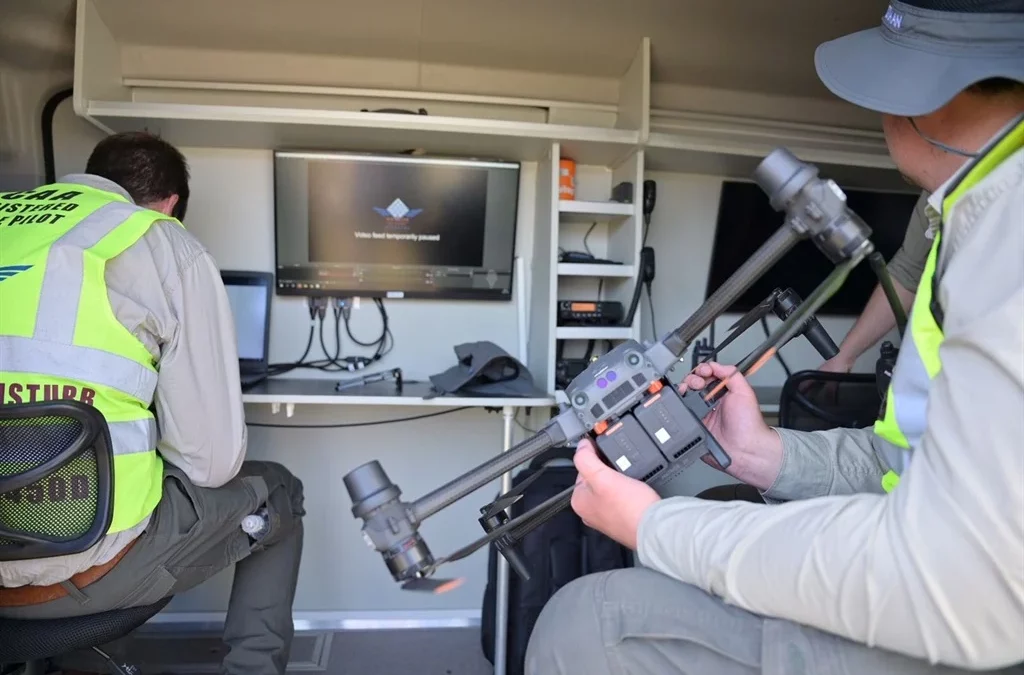
Drones and aerial surveillance technology will also play a part in Cape Town’s hi-tech crimefighting plan. Earlier this year, Hill-Lewis said that with drones, “we can be basically anywhere within four or five minutes, giving our commanding officers on the ground much better intel.” These drones would also be used to monitor popular hiking trails during the upcoming summer season.
The City of Cape Town is also expanding its CCTV network, with plans to pump R50 million worth of camera tech into areas like Baden Powell Drive, Central Business Districts in Goodwood, Wynberg, Kuils River and Parow, Nolungile and Nonkqubela stations, Hanover Park, Manenberg, and Nyanga. These “digital eyes” will all link operational command centres via the Emergency Police Incident Control or EPIC software system, described as the “brain”. “We’re [also] rolling out centralised command, control, and dispatch technology from our Cyclops control rooms,” said Hill-Lewis.
The return of gunshot location technology – described by Hill-Lewis as the “ears” – will also be included in this tech-led approach. This network of audio sensors detects when and where a shot is fired, allowing law enforcement to respond quickly. The ShotSpotter system, used between 2016 and 2019, at a cost of around R32 million, was criticised as being ineffective – at a massive cost – in stopping murders on the Cape Flats. Despite the criticism, Hill-Lewis confirmed that the gunshot location technology would be reintegrated into the City’s crimefighting strategy.